

GERDA BRENTANI
Gerda Bretani was born in Trieste on February 27, 1906, before World War I, when Trieste was still an Austrian city. The only seaport in the Austro-Hugaro Empire, was, in addition to being a rich and culturally alive city, a meeting point for the most varied European nations. Italian, German, Greek and all the languages of the Middle East were heard, in addition to the picturesque local dialect. This mix of civilizations had a marked influence on the people who lived in Trieste at the beginning of the twentieth century.
Gerda's first drawing was born in 1913. It depicted a white, eyeless lizard that she saw in the Grutas de Postumia. A few verses accompanied the scribble. The family showed such enchantment that Gerda, frightened, didn't want to draw anymore. She studied piano and graduated from the Giuseppe Verdi Conservatory in 1926.
She arrived in São Paulo, in 1939, with her husband and two children. In the first few months, she met the painter Paulo Rossi, the architect Bernhard Rudovsky and the sculptor Ernesto de Fiori. Rudovsky saw in Gerda's house some drawings that illustrated stories she invented for her little girl Gini. The drawings ended up in the hands of Paulo Rossi and De Fiori who encouraged her to develop her graphic talent, De Fiori giving her drawing lessons and Rossi offering her work in his ceramics atelier. Gerda's first colorful paintings were born in this atelier and there she met Hilde Weber, Giuliana Giorgi, Alfredo Volpi and Mario Zanini - precious friendships that have never faded.
Invited by Sergio Millet, at the time an important contributor to “O Estado de São Paulo”, she wrote and illustrated the column “Observando” for the newspaper. Carmem de Almeida “Capitu”, when director of the “Feminine Supplement” of the newspaper “O Estado de São Paulo” invited Gerda to write children's stories for publication in this supplement. This collaboration resulted in a collection published under the title “PSIUUU....”, by the publisher Giroflé, in 1963 and republished by the Editora àtica in 1998.
Always curious to try new techniques, she tried oil painting. This, however, was not her means of expression and from this period only five or six works were left.
At this stage her drawing was black and white and clearly humorous. Some of these works were published in book form by the publisher Habitat in 1955. The book, entitled “Atrás da façade” is prefaced by Sergio Milliet
Little by little, without overshadowing the humorous trait, colors begin to appear in her work.
In addition to her work strictly linked to drawing, mingled with the artistic and cultural milieu of the time, she actively participated in the Board of Directors of the Museum of Modern Art during its restructuring period. She has participated several times on the Board of Directors of the Clube dos Artistas “Clubinho” of which she is a founding member. She worked at the Municipal Committee of Culture during the Faria Lima administration.
In 1961, without abandoning drawing as a systematic work, under the guidance of Marcelo Grassmann, she followed the path of metal engraving, in all its modalities. As a result of this learning, there are 40 plates representing a Brazilian bestiary, commissioned by Editora César. The first volume of this series containing 10 engravings, was published in 1969, prefaced by Prof. Paulo Emílio Vanzolini.
With a curious and restless temperament, she continued in 1978 a work begun in 1957 and interrupted for many years. It was the record, in colored drawings, of the oldest parts of the city of São Paulo. Walking the streets, fascinated by the mad growth of the metropolis, her interest was fixed in the old houses, mansions, churches, factories and towns that had withstood the apocalypse of development.
The work lasted six years; there were hours and hours of wandering live sketching the old buildings. This work about São Paulo was presented in three exhibitions and published in the book “São Paulo - Casas e Fachadas”
Between 1986 and 1991, Gerda drew Brazilian and imaginary animals. Some of these works were presented at the Grifo gallery, in 1991.
In 1997, at the age of 91, the exhibition of the series “Terra Papagalorum”, a series of 31 drawings made between 1987 and 1989 dedicated to animals and other fauna and “Antropopholosophia” was held at the Museum of Contemporary Art at USP, curated by Alice Brill : 14 drawings and respective texts that synthesize the life of man on earth and his eternal rebirth.
In 1993 Companhia das Letrinhas released “Eu me Remember”, a children's book narrating how Gerda saw the technological advances of her time, widely used in schools and in 1996 Editora Ática released “Trancatudo”, both with text and illustrations by Gerda.
In 1998, Gerda was honored by the Salon de Humor de Piracicaba, in its 27th edition, with the exhibition “O Mundo de Gerda Bretani”.
On June 26, 1999 we lost the artist but her traits, humor and diversity remain.
Gerda's first drawing was born in 1913. It depicted a white, eyeless lizard that she saw in the Grutas de Postumia. A few verses accompanied the scribble. The family showed such enchantment that Gerda, frightened, didn't want to draw anymore. She studied piano and graduated from the Giuseppe Verdi Conservatory in 1926.
She arrived in São Paulo, in 1939, with her husband and two children. In the first few months, she met the painter Paulo Rossi, the architect Bernhard Rudovsky and the sculptor Ernesto de Fiori. Rudovsky saw in Gerda's house some drawings that illustrated stories she invented for her little girl Gini. The drawings ended up in the hands of Paulo Rossi and De Fiori who encouraged her to develop her graphic talent, De Fiori giving her drawing lessons and Rossi offering her work in his ceramics atelier. Gerda's first colorful paintings were born in this atelier and there she met Hilde Weber, Giuliana Giorgi, Alfredo Volpi and Mario Zanini - precious friendships that have never faded.
Invited by Sergio Millet, at the time an important contributor to “O Estado de São Paulo”, she wrote and illustrated the column “Observando” for the newspaper. Carmem de Almeida “Capitu”, when director of the “Feminine Supplement” of the newspaper “O Estado de São Paulo” invited Gerda to write children's stories for publication in this supplement. This collaboration resulted in a collection published under the title “PSIUUU....”, by the publisher Giroflé, in 1963 and republished by the Editora àtica in 1998.
Always curious to try new techniques, she tried oil painting. This, however, was not her means of expression and from this period only five or six works were left.
At this stage her drawing was black and white and clearly humorous. Some of these works were published in book form by the publisher Habitat in 1955. The book, entitled “Atrás da façade” is prefaced by Sergio Milliet
Little by little, without overshadowing the humorous trait, colors begin to appear in her work.
In addition to her work strictly linked to drawing, mingled with the artistic and cultural milieu of the time, she actively participated in the Board of Directors of the Museum of Modern Art during its restructuring period. She has participated several times on the Board of Directors of the Clube dos Artistas “Clubinho” of which she is a founding member. She worked at the Municipal Committee of Culture during the Faria Lima administration.
In 1961, without abandoning drawing as a systematic work, under the guidance of Marcelo Grassmann, she followed the path of metal engraving, in all its modalities. As a result of this learning, there are 40 plates representing a Brazilian bestiary, commissioned by Editora César. The first volume of this series containing 10 engravings, was published in 1969, prefaced by Prof. Paulo Emílio Vanzolini.
With a curious and restless temperament, she continued in 1978 a work begun in 1957 and interrupted for many years. It was the record, in colored drawings, of the oldest parts of the city of São Paulo. Walking the streets, fascinated by the mad growth of the metropolis, her interest was fixed in the old houses, mansions, churches, factories and towns that had withstood the apocalypse of development.
The work lasted six years; there were hours and hours of wandering live sketching the old buildings. This work about São Paulo was presented in three exhibitions and published in the book “São Paulo - Casas e Fachadas”
Between 1986 and 1991, Gerda drew Brazilian and imaginary animals. Some of these works were presented at the Grifo gallery, in 1991.
In 1997, at the age of 91, the exhibition of the series “Terra Papagalorum”, a series of 31 drawings made between 1987 and 1989 dedicated to animals and other fauna and “Antropopholosophia” was held at the Museum of Contemporary Art at USP, curated by Alice Brill : 14 drawings and respective texts that synthesize the life of man on earth and his eternal rebirth.
In 1993 Companhia das Letrinhas released “Eu me Remember”, a children's book narrating how Gerda saw the technological advances of her time, widely used in schools and in 1996 Editora Ática released “Trancatudo”, both with text and illustrations by Gerda.
In 1998, Gerda was honored by the Salon de Humor de Piracicaba, in its 27th edition, with the exhibition “O Mundo de Gerda Bretani”.
On June 26, 1999 we lost the artist but her traits, humor and diversity remain.
SELF-INTERVIEW
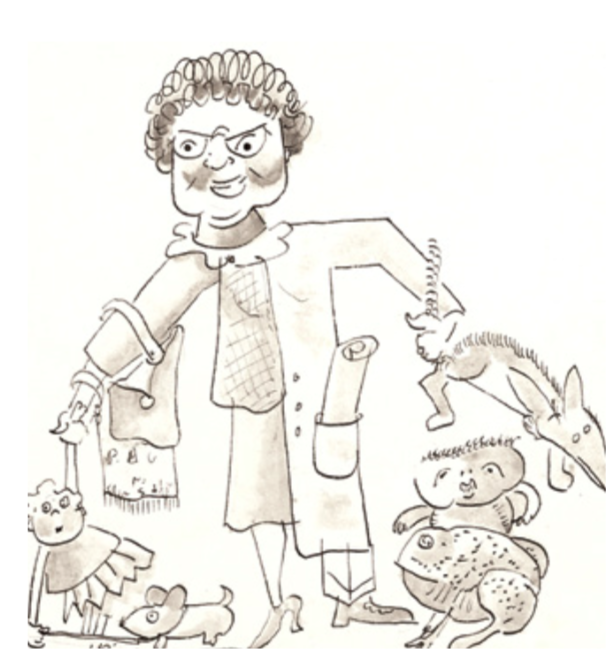
What I write is not a criticism, nor a protest, nor a documentary correction. The words self-taught, autobiography, self-analysis exist and make sense.
So why not say self-interview? The self-question certainly facilitates the autoresponder and everything becomes clearer and more self-sufficient.
I share some questions addressed to me by a group of sweet girls, students from (Colégio Dante Aligheri). I swear to tell the truth only etc.
I. What do you like to eat?
II. What kind of man would she choose for a husband?
III. Of modern comedians, you prefer
Daumier or Steinberg?
IV. There were no questions - I lost patience.
A.P. is self-question and A.R. is self-report.
A.P. How do you like to organize your day-to-day?
A.R. Accept an explanatory scribble (image on the side)
So why not say self-interview? The self-question certainly facilitates the autoresponder and everything becomes clearer and more self-sufficient.
I share some questions addressed to me by a group of sweet girls, students from (Colégio Dante Aligheri). I swear to tell the truth only etc.
I. What do you like to eat?
II. What kind of man would she choose for a husband?
III. Of modern comedians, you prefer
Daumier or Steinberg?
IV. There were no questions - I lost patience.
A.P. is self-question and A.R. is self-report.
A.P. How do you like to organize your day-to-day?
A.R. Accept an explanatory scribble (image on the side)
As can be seen, Gerda is divided into two parts. On the one hand the right wife, the reasonable housewife, no social ambitions. Feeling: the most gratifying one is to be a mother, grandmother and great-grandmother, with a lot of dedication to the offspring.
The other Gerda is a massive piece of curiosity. She watches the world with all that it has to live in its thousand varieties.
The other Gerda is a massive piece of curiosity. She watches the world with all that it has to live in its thousand varieties.
Their habits are simple. No fight to have tutú, diamonds and froufrou, sometimes they would find it practical to have a driver, but for what? Both like kashmir pullovers, caipirinha and ice cream and hate cinnamon, garlic and classic ballet with trembling.
A.P. Do you see life more from the happy side or from the sad side?
A.R. i I don't know how to answer this question. How to separate the two feelings that are always so present in our existence. Joy, sadness, the good, the bad, follow, mingle. The important thing is to know that it is worth living.
Says G. ii: I think the pessimist is a sad figure, but the optimist is a poor beast.
A.P. Do you think your drawings bring joy?
A.R. I think so, at least 40% of my audience enjoys my exhibitions. (calculation done by the Institute of Statistics on prosillating creativity).
A.R. i I don't know how to answer this question. How to separate the two feelings that are always so present in our existence. Joy, sadness, the good, the bad, follow, mingle. The important thing is to know that it is worth living.
Says G. ii: I think the pessimist is a sad figure, but the optimist is a poor beast.
A.P. Do you think your drawings bring joy?
A.R. I think so, at least 40% of my audience enjoys my exhibitions. (calculation done by the Institute of Statistics on prosillating creativity).
A.P. Why your preference in drawing animals?
A.R. Partly for the pleasure of observing the infinite variety of beings that nature has created. Partly because I find certain species so similar to man and sometimes this similarity shows us that homo sapiens is not all that sapiens.
A.P. And your age, your eighty years?
A.R. I calmly accept the passing of time. Sure, the changes are many, but they proceed slowly. Pleasures are others always in minor and slightly boring tones. Renunciations are restful - let's be frank. In the years of good life I sometimes took a solemn and healthy drink. I think now a binge would be neither solemn nor very healthy.
A.P. What are your ambitions now?
A.R. Modest, I believe. To be able to draw to the end. See a book about animals that came out of the oven this September 86, and have my loves with me in full possession of the head and legs.
A.R. Partly for the pleasure of observing the infinite variety of beings that nature has created. Partly because I find certain species so similar to man and sometimes this similarity shows us that homo sapiens is not all that sapiens.
A.P. And your age, your eighty years?
A.R. I calmly accept the passing of time. Sure, the changes are many, but they proceed slowly. Pleasures are others always in minor and slightly boring tones. Renunciations are restful - let's be frank. In the years of good life I sometimes took a solemn and healthy drink. I think now a binge would be neither solemn nor very healthy.
A.P. What are your ambitions now?
A.R. Modest, I believe. To be able to draw to the end. See a book about animals that came out of the oven this September 86, and have my loves with me in full possession of the head and legs.

A.P. Would you like to be remembered by posterity?
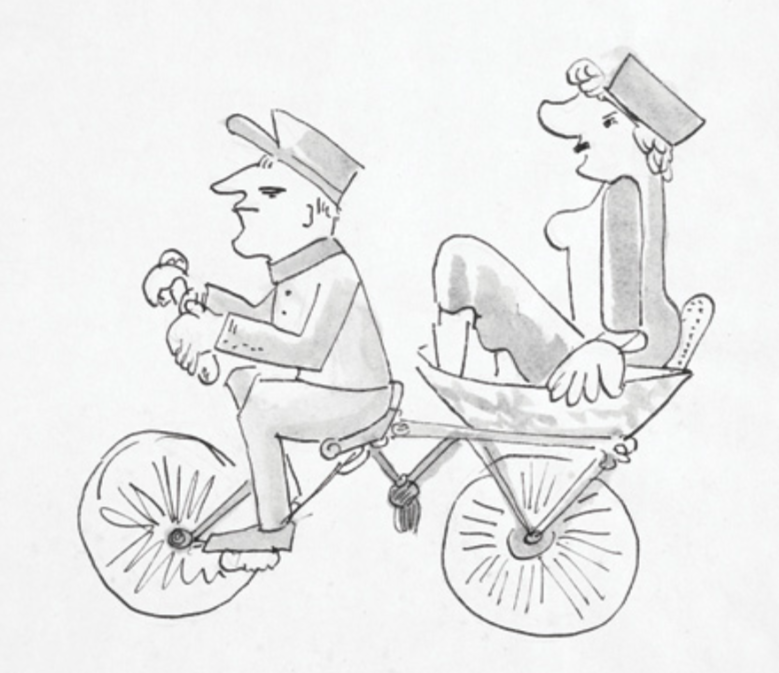
A.R. I think it is a process that does not depend on me. Plugged in several files I already am. Do I deserve a biography? I do not know. And if well-meaning citizens would dedicate a statue of mine from my day to the city, it would certainly look like this. (top image)